
A couple years ago in an article about trailer safety chains, I mentioned the “Link Lock” system. It looked pretty interesting, and I like creativity, especially when it solves real problems. So, I tried to connect with the company to learn more. As mentioned in the previous article, I was not able to connect with the company at the time.
Apparently, a friend of the LinkLock Company saw our article and pointed it out to the owner. The owner then called me, and it was a great conversation. He sounds like a really smart guy. Anyway his system that he calls “Link Lock” is indeed pretty cool. After talking with him a little bit, he sent me one of his systems to examine and test. This article is my thoughts on that system.
Disclaimer. While the system was sent to us free, there are no promises or promotions given. No further relationship exists. We are free to review the product, and give our honest opinions. That is the context of the article below.
The Link Lock System
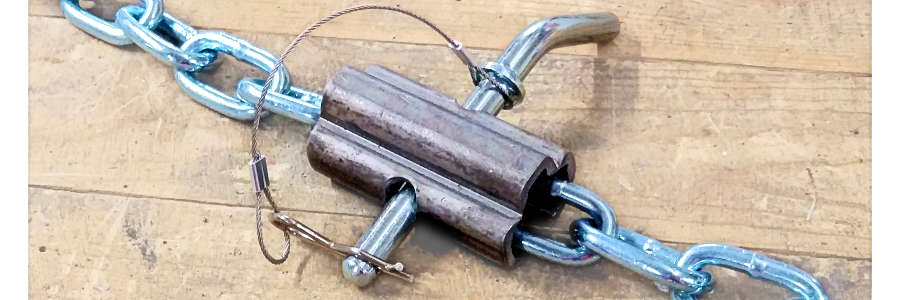
I will refer you to their website for details about their system. The essence — Link Lock is a mechanical system to easily adjust safety chain length to match for your trailer and tow vehicle. You install it on your trailer, then adjust the safety chain length to fit the tow vehicle.
 The adjustment comes by using a formed channel of steel which welds to the tongue of the trailer. The shape allows safety chain to slide nicely through it. You slide the chain until it is the desired length, then pin it in place. Do that for both sides (both chains).
Adjusting chain length, it’s as easy as pulling a spring clip, then a solid pin.
There is a lot of good thinking in this product. Not just the chain and its path, but also the little details. One clever touch is the little cable to keep the spring clip on a tether. I can see how this is very useful to keep from dropping or losing the clip. The kit even comes with slide-on retainer rings to secure the cable on the main pin. Very nice job with the finishing touches.
Sizes
Link Lock offers the product in a few different sizes for different capacity trailers. He sent me the 5/16″ model, which I assumed meant 5/16″ thick chain. However, my 5/16″ chain jams in the hole. I know chain is not universal, so there may be other 5/16″ chains that fit through. Anyway, I don’t know what the size numbers represent. For me, the 9/32″ chain worked very well.
The pin to hold the chain works super well. Just slide it through, clip it, and it’s done. The long “handle” of the pin is a nice touch also. The instructions point out that it serves multiple functions for helping to tame your chains. Again, good thinking with the development of this product.
Security
Yes, security is the meat of this product. However, let’s talk about security in two parts. First, security of this system on your trailer, as in things getting stolen or vandalized. Second, functional security of the trailer attached to the car should you ever require the safety chains.
Functional security is the reason safety chains even exist. So, with respect to the Link Lock system, that is obviously most important.
Security of the System
 This is a weld-on system. The formed steel piece welds to the tongue of your trailer which makes the channel very secure. On the other hand, it would be super easy for someone to take the pin and safety chains. To solve that, it is easy enough to take the chains with you after parking the trailer. (Some thieves use the chains to steal a trailer, so removing them makes that more difficult. The thief would have to bring his own chains and pins.)
So, it’s a mixed bag for theft security. If you leave the chains on the trailer they are easy to steal. If you take the chains, you have to keep them somewhere. A bit of a hassle, yes, but it without chains, the trailer is more difficult to steal. I suppose you could put a lock on the end, or weld a large ring on the loose end of each chain so it won’t pull out.
Here’s a little more on this type of Trailer Security.
Functional Security
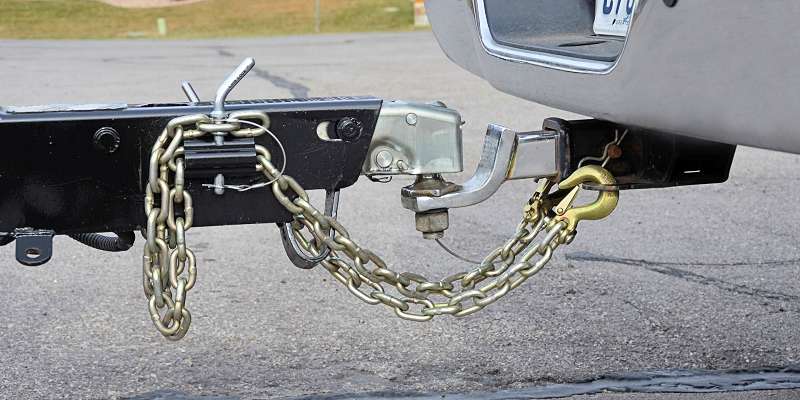
As mentioned in our previous safety chain article, length of safety chains is a big deal with respect to functional security of the trailer being towed. If the chains are long, lots of bad things can happen. If we keep the chains short, it will limit the potential for disaster.
This is the reason for the Link Lock system to exist, and I think they have solved the problem very well. With this system there is no reason to ever have the wrong length for your safety chains — no matter what vehicle you tow with.
In functional security, this system shines. With the Link Lock system, you can adjust chain length very easily so they are as short as practical, and therefore reduce risk. This ensures greater security (safety) when pulling a trailer. With this system, because it adjusts so easily, you can get it right every time.
Critique of the Link Lock System
There is so much good about this system, and how it works. That makes it hard to argue disadvantages. Potentially security of the system as above, then perhaps 3 minor things to think about. Well, let’s make it 4 things.

- It is a weld-on system that requires a flat area of several inches to attach — ideally close to the hitch. It also requires a bit of “clear runway” in front for the chain. Welding is good, yet there are also good arguments for a bolt-on. (I suppose you could weld it to a plate, then bolt the plate to the trailer tongue.) Update: The owner of Link Lock says there is a bolt-on version for the 5/16″ size. I can’t find it online to share a link, however.
- Because of the formed Link Lock channel, the chain cannot rotate inside. That keeps a link horizontal so the pin can easily slide through. That’s good, right? Yes, though it also limits the pin connection to every-other link. In other words, the resolution for chain length is 2 links. Also, you must insert the 2 chains the same way (with respect to the number of links from the hook) or they won’t be the same length.
- While the pin makes a secure connection, the system focuses on ease of chain length adjustment. That means it has extra baggage if you always pull the trailer with the same vehicle. Yes, you can replace the pin with a bolt to get rid of the extras, but that defeats some of the purpose.
- I’ll throw in a 4th point. Cost, as compared to other options. (Safety is not the place to cut corners, so take this point with a grain of salt.) Link Lock is not an expensive product, but compared to other ways of mounting safety chain, it is kind of expensive. This is just a niggle.
Our Recommendations
Overall I think this is a great product. The system design is good, and I believe it will definitely do the job. Thumbs up here.
I did not install it, but I may yet do that. It is good enough to have on my trailer, but I don’t really want to remove the nice powder coating to weld it on. Hmmmmm. I’d say, think about this Link Lock system for the next trailer you build. I certainly will, and I have already suggested it to a few other people.
For this article, I wish to emphasize that the above list of disadvantages are very niggly. Things to think about, but don’t let that list bias you against the product. Overall, in my engineering opinion, this is a good design. I think this is a cool product with sound engineering, and I have no doubt it will hold up if things go haywire.
Thank you, Link Lock, for letting us evaluate this safety chain system. We appreciate both the opportunity and the design of the product.
Please, check out the LinkLock Website for more information. Do a google search for places to buy.
Link Lock Patent
OK, I’m an engineer that likes to look at things a little different. I see the list of disadvantages above, and immediately think about Solutions! BUT, this system has a patent, and I respect the intellectual property of others. I will ask you, also, to please respect the patent. If you want this, please buy the product from Link Lock.
Interestingly, I found Link Lock because I was working on a idea that is sort of similar. Going back to the beginning of this article, I tried quite a few times unsuccessfully to reach Link Lock when I first discovered them. Since I could not reach them, I took the opportunity to download the patent (uspto.gov) and review it in depth. I want to make sure what I am doing is not already under someone’s patent, like the Link Lock patent. After a good review, I believe the concept I was considering is outside of this patent.
If you’d like to see the other concept(s), check out the article on Improving Trailer Safety Chain Connections. It talks about how we got there, and shows some other adjustable chain attachment ideas. Finally, we also have Free Plans for the adjustably permanent Chain Anchor system. Enjoy.
Good Luck with your safety chains. Thank You for Visiting.





Comments