

You have the heavy-duty pickup, and you have built the perfect trailer. Now you are ready to haul – but someone mentions, “You might need a CDL for that.” Wait, what? But, this is for my personal use!?! It’s not commercial.
The Commercial Driving License (CDL) is not just for semi-trucks, and it is not just for commercial operations. Depending on your truck and trailer capacities, you might be closer to the requirement than you think.
At Mechanical Elements, we design trailers of all sizes, and some of our trailer plans definitely fall into CDL territory. So, know the rules. It is worth finding out where the line is before you build or tow.
When do I need a Commercial Driving License?
We get variations of these questions once in a while.
- Are there driving license requirements for pulling a trailer?
- How large of a trailer can I pull without a CDL?
- When do I need a CDL – Commercial Driving License – to pull my trailer?
- When do I have to pull into weigh stations?
They are good questions, because even if your activity is not “Commercial” in nature, some rules apply. You do not want the hassle or cost of dealing with legal troubles that will come if you violate the rules.
So, we will dive in, but first, let me just say I am not the expert on CDL’s. This is general information ONLY. There are variations of the CDL – Class A, B, Toxic Chem, and more – then, some states have restrictions as well. So, for questions about your situation, please contact your local authorities.
Here are the rules as I understand them. (Please correct me in the comments below if I’m wrong.) We will look specifically at the area often considered “Light Trailers” even though they are not “Light”. (Compared to over-the-road trucks, the things you pull with a pickup truck are considered “light”.)
You Must Have A CDL IF . . .
From what I understand, these are the requirements for when you do need a CDL – Commercial Driving License.
- The need for a CDL is based on the combined CAPACITY of your complete rig. That is BOTH the truck and trailer.
- A combined total capacity of 26,000 lbs is the requirement limit. At 26,001 lbs you need a CDL. (Often called the Gross Combined Weight Rating, or GCWR.)
- It does not matter if the Truck or Trailer are full or empty. If the rig is capable of carrying the CDL load, then you need the Commercial Driving License.
- The trailer capacity of 10,000 lbs (or more) appears as a threshold. Sometimes a Class B CDL is required. Check your local requirements, because some states require a CDL if you can carry 10,000 lbs – even if your total GCWR is less than 26,000.
- In the USA, Federal CDL rules apply for interstate commerce. Some state-level (intrastate) rules are stricter.
- For our purposes here, we will skip the rules involved with special purposes like busses, hazardous material transport, combined (multiple) trailers, etc..
Find out from your local jurisdictions about rules that apply to you.
Talking Through Some Examples
The above rules can often be a bit confusing. Some say any trailer over 10,001 lbs GTWR will automatically need a CDL. That is not true, but it can be in certain situations. Let’s look at it.
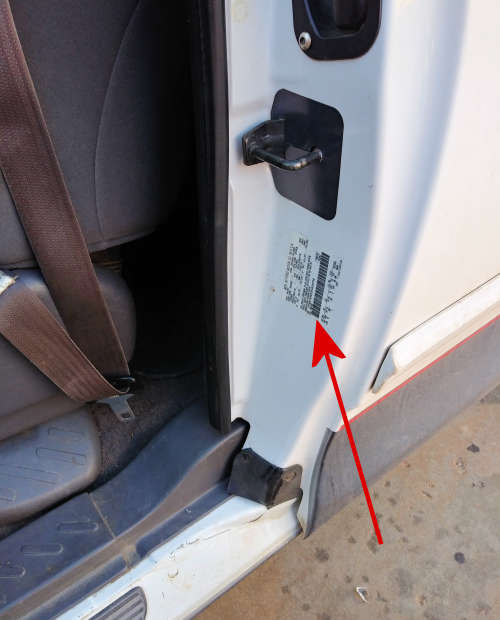 GVWR = Gross Vehicle Weight Rating. Assigned by the manufacturer and printed on the vehicle (usually a sticker on the door jam). See the image. This is a max rating, and has nothing to do with the actual load in the vehicle. The numbers often show by axle, front and rear. See this article on Towing Capacity.
GTWR = Gross Trailer Weight Rating. This is the total load capacity for the trailer (usually noted on a tag near the front drivers side of the trailer). Often the tag is metal. If you are building your own trailer, it is usually the combined axle capacity, but as noted below, there are sometimes reasons to derate the total.
How much of a trailer can we pull before we need of a CDL? Following this equation: 26,000 lbs (CDL limit) minus the Tow Vehicle GVWR = Available Trailer Capacity. Here are some examples based on Ford published values. (Other manufacturers are similar.)
| Tow Vehicle | Tow Vehicle GVWR | Allowable Trailer Capacity |
|---|---|---|
| Ford F250 4×2 Reg | 10,000 lbs | 16,000 lbs |
| Ford F250 Crew | 10,500 lbs | 15,500 lbs |
| Ford F350 Crew | 11,500 lbs | 14,500 lbs |
| Ford F350 DRW | 14,000 lbs | 12,000 lbs |
Allowable Trailer Capacity is the maximum trailer GTWR to stay under the CDL requirement. If your trailer capacity is less than this, and if your tow vehicle is specified by the manufacturer to tow the weight of your trailer, then, on first blush, you do not need a CDL — but find the data from your vehicle.
Another Way To Look At It
- A 12,000 lbs capacity trailer requires a truck of less than 14,000 lbs GVWR, or you will need a CDL.
- A 14,000 lbs capacity trailer requires a truck of less than 12,000 lbs GVWR, or you will need a CDL.
But be careful with the rules for trailers above 10,000 lb. capacity (GTWR). Check your local rules.
Note: The numbers above do not take into account the Gross Combined Weight Rating, or the Tongue Weight Limits for the tow vehicle. You must stay within all of those limits.
Warning: Do your own math for your specific vehicle and trailer. The above chart is only examples.
The 10,000 lb Rule (for Some States)
Some states have tighter regulations for a CDL. I understand they vary, but here is the way I understand the 10,000 lb rule.
Some states (in the USA) require a CDL if you can carry 10,000 lbs – even if your total GCWR is less than 26,000 lbs. This is extra, and you must abide whichever is lower: the 26,000 lb rule, or this 10,000 lb rule.
- Example explained to me. If you have a 14,000 lb capacity trailer, and it weighs 4,000 lbs, then it can carry 10,000 lbs, so you need a CDL – regardless of the tow vehicle.
- Second example. If you have a 10,400 lb capacity trailer, and it weighs 3,400 lbs, then it can carry 7,000 lbs. If your truck is heavy duty, and it can carry 3,001 lbs, then the combination of 7,000 lbs + 3,001 lbs = 10,001 lbs. So, you need a CDL. Even when the total, (truck = 11,500 GVWR + trailer = 10,400 GTWR), is less than 22,000 GCWR, which is less than the 26,000 lbs as defined at the federal level.
Again, please correct me in the comments if I am wrong.
I wonder if I am wrong, because in the examples above, and looking at the rules below, I see a mismatch. If a 9900 lb capacity trailer does not need a CDL at all, then it does not matter what truck is pulling it, so the total combined carry weight can be over the 10,000 lb rule, but still not need a CDL. Weird.
Yes, these are state specific, and I know laws can get strange, but . . . . Please comment if you know the rules better.
No matter what, please check your local laws.
Common Exceptions & Exemptions
As I understand it, there are some exceptions, but they are pretty specific. Here are just a few.
- Farm Vehicles. Many states exempt “farm vehicles” operating near the farm, even if on public roads for short bits. (Good thing because I drove some mighty big loads of hay and manure as a kid.)
- Vehicles not on public roads. For construction vehicles and such, there are often exemptions when the primary use is off the public roads.
- For our purposes we will not go into exceptions for military, emergencies, or others.
Again, find out from your local jurisdictions.
You Do NOT Need A CDL For These
While some of these items below are similar to the list above, these are conditions where you do not need a CDL.
- A CDL is usually not needed for trailer capacities less than 10,000 lbs.
- You don’t need a CDL (or any license for that matter) for driving on private property – not on any public roads – like on a farm.
- You DO need a driving license for driving on Public lands, like BLM land, but you don’t usually need a CDL if you stay off the roads. (However, you must stay on existing paths and trails.) Other rules apply for off-highway vehicles. If your vehicle transitions from off-road to on-road, all the normal highway licensing, registration, insurance, etc. rules apply.
- There is some gray area with RV’s. With large RV trailers, you may cross into rules where you technically need a CDL or special non-commercial license. For example, some states require a non-commercial specialty license or endorsement for large RVs rather than a full CDL. Often you can “get away with it” for an RV because it does not “feel” commercial, so authorities may not strictly enforce the capacity rules. It is always best to know for your situation first.
- Other minor conditions we will not go into here.
The real take-away in these lists: Check your local requirements before pulling a large or heavy trailer without a CDL (Commercial Driving License).
Tricks To Avoid The CDL Requirement
Here are some tricks people use to get around the need for a CDL. I list them with a Warning: Stay true to the specs, and Be Smart. Violations are not pleasant; and Unsafe is never acceptable.
- De-rate your trailer. For example: If you have a 3500 lb axle, it does not mean you must put 3500 lbs on the trailer.
- Some people derate a trailer from 3500 lbs to 2990 lbs to avoid brake requirements. (Usually required for trailers over 3000 lbs GTW.)
- Some will derate a 10K trailer – technically 10,400 lbs – to 9990 lbs. That is below the 10,000 lb rule. (But, do not exceed 9990 lbs GTW because if weighed, it will create big trouble.)
- Following the example in the table above, if a F350 DRW is 14,000 lbs GVWR, and a trailer at 14,000 lbs GTWR, derate the trailer to 11990 lbs so you don’t need a CDL. Of course, don’t load it over 11990 lbs, but if that works for you, then great.
- To derate a trailer, clearly put the capacity on the trailer. Often this must be done by the DMV (Department of Motor Vehicles), so it is on the official tag.
- Use a lighter rated truck. Be smart about it – excess can be dangerous – both vehicle ratings and hitch class ratings. Using a lighter capacity truck allows more capacity for the trailer without needing a CDL.
- Please Note: The legal requirement to need a CDL is the total combination capacity, not the scale weight. However, the Safety is actual weight, distribution of weight, and recommended max loads. The 2 are different, so be smart.
- Older trucks typically have lower capacity ratings. Drive an older truck (that is rated for pulling your trailer), then the GCWR is less.
These tricks can be useful in some situations – if you are safe. Nothing is worth the risk of killing someone, or causing a horrible accident.
What Are The Requirements To Get A CDL?
There are a ton of requirements, too numerous to list here, but I will highlight a few.
- You must already have a standard driving license (for passenger vehicles).
- Meet age requirements, typically at least 18 years old. Or, 21 years old to drive commercial across state lines (interstate).
- Medical / Physical Qualification means a medical examination and certificate (often referred to as a DOT physical).
- Normally, you must prove your identity, legal status (U.S. citizen or authorized), and provide documents with a Social Security number, proof of residence, etc.
- A clean driving record (no disqualifying violations). Usually that means the past 10 years.
- Pass a written test of commercial vehicle operations, safety, rules, and specifics for the endorsements you seek.
- Pass a driving skills test in a vehicle of the class for which you are applying. First-time CDL applicants (or those upgrading to a higher class), must complete a training program before taking the skills test.
- Pay the fees. Of course there are fees.
- Some states have extra requirements (like, additional vision standards, training hours, etc.).
Again, I am not the expert, but these are some typical requirements.
What Are The Responsibilities Of A CDL?
As I understand it, there are some pretty serious responsibilities with a CDL. If I understand right, you are held to higher standards as a driver – even if you are driving in your car.
When you carry a CDL, the law expects more when operating a vehicle – all vehicles. The “commercial driver” label implies you are professional and thus must operate more safely. What does that mean?
More severe consequences for traffic violations. Common infractions that might be a warning or a small fine for a noncommercial driver, can have heavier penalties for CDL holders. Things that happen when driving your passenger car can affect your CDL status – in other words, you can lose your CDL for something another driver would simply get a fine for.
There is a lot about this that seems very unfair, at least to me. Honestly, I would love to have the training so if occasion arises . . . but with the harsher penalties listed above, I have no desire to do it. I tend to drive conservatively with a truck and trailer, but not so much when on a bullet bike.
My Take:
I personally believe every driver should be required to have more training. The tests should be far more thorough. I also think skills testing should be much more demanding, and required every 10 years or so.
Punishments for things that are blatantly unsafe choices – like texting and DUI – should be more severely penalized. And, I think consequences should reflect the situation. I don’t mind more severe consequences for CDL carriers when driving rigs that need a CDL, but when you are driving a car, the consequences should be fair for everyone driving a car.
Now we have covered the CDL as it relates to lighter trailers, indulge me for a moment as we look at the broader picture of trailer safety and how people actually behave on the road. Many people tow responsibly, but not all have the same experience or judgment. So, the question: How do we, together, raise the level of safety for everyone on the road?
Should We Have License Requirements For Towing?
Personally, I feel like there is a large gap between the standard driving license you get as a teenager, and the strict requirements of a CDL. I like the idea of higher standards when managing something that is much larger and heavier than other things on the road. From a safety standpoint that seems right to me, and having a superior driving license, like a CDL, is a reasonable tool to get there.

I would go a little further on the topic of trailers, however. Pulling any type of a trailer is more complicated than driving without one. Yet, as a society we allow any inept fool to hook up and put everyone else at risk. That seems very short-sighted.
We have precedent for variations in driving licenses. Even CDL’s have different levels – large rigs, passenger carrying, toxic chemical, etc.. For a Motorcycle endorsement, I had to bring a bike, drive a bunch of maneuvers, and demonstrate that I knew how to handle it. Why not the same for trailers? Bring a trailer and demonstrate, through various scenarios, they know how to maneuver it.
I actually think there should be 2 levels of trailer endorsement – one for any small trailer, and one for trailers over a certain length – like 20 ft – ball to end. These endorsements should be required even before we talk about a CDL. In my opinion.
Heaven knows there are many inept drivers, and even worse in front of a large trailer. I agree with improving safety on the road by weeding out people that should not be in the driver’s seat. I personally think adding education and expectations can go a long way to solving some of the silly problems, and accidents.
What do you think? Please leave a comment.
Good luck in all your towing!
We appreciate your kind contributions.
Thank You.








Comments