

There are many different sizes and shapes of the suspension equalizer link. What are they for? Better yet, when should I choose one shape over another?
If you have read much on this website, then you know we are strong proponents of having multiple axles share the load – not overloading one or another. An Equalizer link helps for leaf springs. But, which one? There is a short article on eTrailer that gives a taste of various equalizers, but not much detail.
Tradition puts the various shapes in certain industries, but we don’t really know why. Some of the “lore” does not make a ton of sense. Anyway, I am sure they had great reasons, and we would all say “Oh, yeah“, if we knew. But, I diverge. Let’s look at some engineering, kinematics and other interesting info.
The Suspension Equalizer Link
Starting basic. What are we even talking about when we say “Suspension Equalizer Link”? There are many trailer axle types, but the equalizer link is unique to leaf spring style suspensions when used in multiple axle configurations. We show tandem axles in the images, but it applies in similar ways to more axles.

Semantics: Sometimes it is called a “Link”, sometimes a “Bar”, sometimes a “Rocker”, or just “Equalizer”. Sometimes other names, but it is all the same.
We have talked previously about the need to “share load” between axles. The article describing what happens if they do not share, gets to the crux. Anyway, the suspension equalizer is the rocking link connecting the leaf springs. It allows the axles to share the load as the trailer goes over bumps and through dips.
If your browser displays it, this animation shows linkage movement as a tandem axle pair goes over a bump. You can see the linkage action, and especially the motion of equalizer link.

As you can see, the suspension equalizer link rocks as the axles articulate over a bump. This link allows the axles to share the load even as one, then the other, rise. See what happens when axles fail to share. Or, try this article about making air suspensions share properly.
The shape in the image is a typical link we commonly see, but there are many other shapes.
Equalizer Shapes
 There are a bunch of different equalizer shapes. The gray image of small parts here shows a few. (Reference image source: Harsco Trailer.)
While there are many more shapes than shown, typically for tandem axles, there are 3 common shapes. See the color image of the 3 equalizers.
Of note, these are suspension equalizer links for trailers with double eye springs. Slipper style springs use a different kind. While they are similar in function, the look and shape is quite different. They are not in this article.
Triple axles need one with a different style, like the 2 in the gray image, upper right. They function similar, but attach directly to the front of the center axle spring, instead of a shackle. That helps with center axle stability.
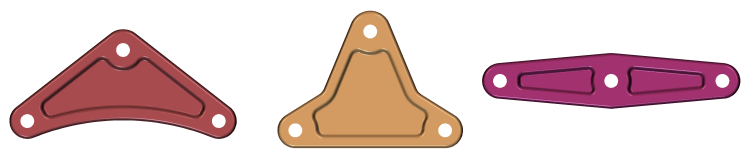
This image shows 3 common styles of suspension equalizer link. While the left one is pretty standard, the outside shape will vary. The middle one is similar, but taller, and as we will see below, that makes a difference. Finally, the straight one has 3 holes inline.
 Look at the relationship of the holes to one another. That is easiest to do when we superimpose them atop each other. Now look at the relationship of the holes. (These 3 are for the same axle spacing. Many configurations exist for length and height for differing applications.)
This stack also shows the links in a relative position where they function on a trailer. Note the height of the center pivot hole. The Tall one needs a short center bracket. The Straight one needs a long center bracket. (Here is what can happen if the brackets are not tall enough.) We will look at this more below.
Why the different shapes? What do they mean? I have heard some explanations, but I cannot make the reasons match the physics. Anyway, we can look at how they work.
Do The Shapes Perform Different?
From a global perspective, they all do the same thing, they are just taller or shorter. However, in physics, that kind of thing matters. So, how they appear in action on a trailer?
Images on the LEFT are with the trailer on flat ground. For images on the RIGHT, note the bump under the one wheel. In these models, the equalizer links are at full stroke.

Now look a little closer. The analysis images below are the same as those on the RIGHT above, but larger, and include some PINK highlights to talk about.
Again, I will point out that we do not know the historical reasons for these shapes. I have heard many things, but some contradict. This is an engineering-based geometric analysis. Actual setups vary by hanger height, shackle length, spring type, and axle spacing.
For this eval, the bump is always the same size. (See notes about practical changes below.)
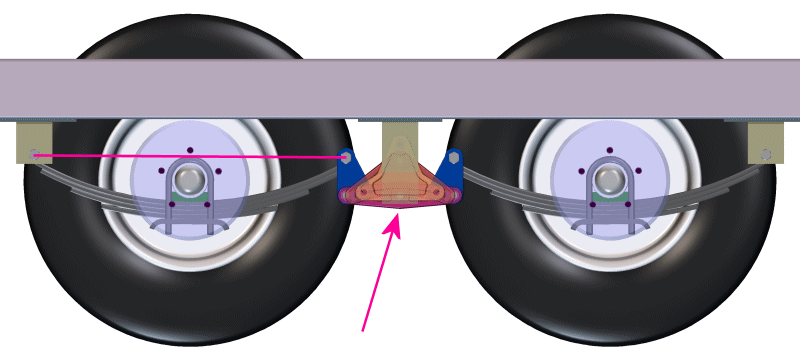
The image shows the start condition for all 3 equalizer links. The transparent area in the center shows the links (PINK arrow). You can sort of see the differing center bracket lengths there too. The center bracket changes for each equalizer in this analysis, so at the start of action, the springs are horizontal – eye to eye. (PINK line.)
Starting With The Tall Triangle:

With this tall suspension equalizer link, if the bump is too big, then the suspension cannot adjust to it while keeping both wheels on the ground. Note the interference of the tire and the bump in the PINK circle. Also, the space still available between the shackle and the trailer frame (small PINK circle).
Here the suspension becomes constrained because the line of action (PINK line) comes in line with the blue shackle link. That is as far as the equalizer can rotate clockwise.
In practice, you would use longer shackles, and you would balance the height of the center hanger bracket (attached to the frame). For illustration, the shackles are the same for all the links so you can see why it needs longer parts.
If these are not set up properly, over a large bump, the RIGHT axle can drop below the PINK line of action, and the blue shackle will end up under the equalizer link. That causes more problems. Anyway, it serves as a good reminder that we must set things up right, so it will work right.
Customer Note:
“Hi. I have a 3 year old Big Tex dump trailer and I have been having an issue of the axle spring shackles shifting and flipping the wrong way. I am not doing anything bad like overloading it. I know to other people who own the same type and have the same issues. I am wondering if you sell something to help prevent this . . . . thanks.”
The tall style of suspension equalizer link is lower to the ground, and as it rocks, it biases the load far more to the front wheel. While it can work with longer parts, it does not balance the load as well as the others. The only advantage I see is the lifting wheel moves more rapidly than the descending wheel. That might help with inertia and make the ride a tiny bit smoother?
I would sure like to know if there are advantages with these that I am not seeing. Please let us all know in the comments if you have more info.
Now The Straight Link

The straight link is a little longer eye to eye than the others. You can see that it needs to be, or (looking at the PINK lines), if they become straight, the suspension constrains. The center spring hanger bracket is quite tall, because the pivot point of the equalizer must be low for the movement. And, as the equalizer link gets longer, the center bracket must get taller.
The nice thing is you can get a lot of suspension travel with one of these. That said, the angle of pivot is greatest with the straight link at the bump height shown.
The long center bracket (PINK circle) must be well supported to be stiff enough. A long, unsupported bracket will make the suspension sway side to side, and sometimes, they will bend right over. That is very bad.
This suspension equalizer link gives the best load equalizing because the forces remain the same on both ends. There is not a load bias as with the “triangle pivots”. This will contribute to longer equipment life, and less “bucking” from the trailer. I wonder if that is why we see these more often on horse trailers?
The Medium Triangle
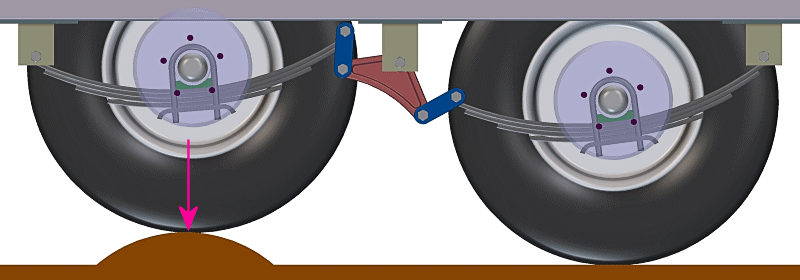
This style is by far the most common. The action is somewhere between the straight and the tall triangle. It does a reasonable job of load sharing, though at the extreme, the lifted wheel will carry more than the rear.
In the configuration shown, it achieves the desired wheel lift without approaching suspension constraints. The rising wheel does move up more, than the other one moves down (with respect to the frame).
This link seems to make a good balance of requirements – maybe that is why it is so popular? It does not share the load as well as the straight link, yet it does not require as much space for motion. This one cannot handle as much bump, but also does not require a really tall center bracket.
We need to recognize that there is more than one geometry for these. In essence, they are the same – a triangle – just not as tall as the one above. There are many on the shelves that are similar, but different, so make sure you get one that meets your needs. Check your suspension recommendations. Often this will be a group of items sold as a kit, or as recommendations by an axle manufacturer for geometry for axle spacing.
Comparing Equalizers
From the perspective of true load sharing balance, the straight equalizer does the best job, but it requires a tall center pivot bracket. See notes for stiffening below.
The typical triangular shape for equalizers helps make the center bracket shorter and therefore not as flimsy. However, as illustrated in the above geometric layouts, as a triangle rocks front to back it pulls away from the spring. So, if the suspension on one side of the trailer articulates and the other does not, then the axles become non-parallel. Not by much, and it does not really matter, but since we are talking theory, it is worth noting.
Looking at this simple analysis, one might conclude that the straight equalizer link has the most advantages. I do not think that is wrong, but it is worth noting that history favors the medium triangle. There is some natural action bias in the kinematics, and that is a point worth considering. On the other hand, if the triangle gets tall, the dynamic analysis starts to get ugly quick. Making other links, like the shackles long to compensate for the triangle seems like a losing proposition.
One point that comes very clear is the need for proper lengths and spacing. Will all the suspension equalizer links, spacing – distance between brackets, distance between axles, etc., becomes really important. Proper function relies on proper set up.
More Thoughts on Suspension Equalizer Links
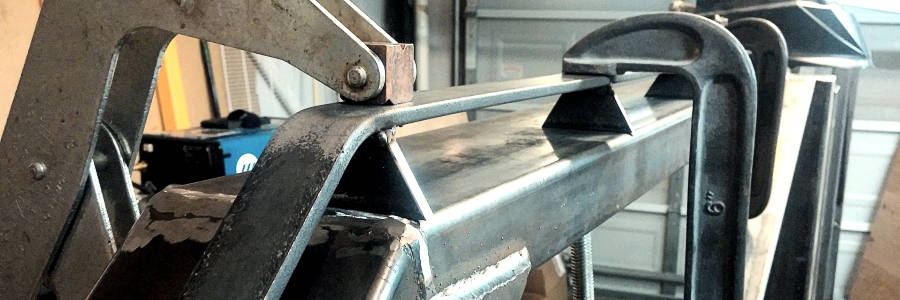
Tall brackets tend to be a little wiggly under heavy loads unless strengthened (stiffened). If you weld something inside to tie the two vertical legs together, then it is easy to go with longer brackets. Another trick is a piece of angle iron or c-channel extending across the trailer, welded to the spring brackets on both sides. That supports the brackets also.
 Brackets are not the only thing with stress. While suspension forces seem straightforward, there is always more to it. This is odd case highlights that.
What suspension link should you choose? Look at the images above, then read again about the advantages. Look at your trailer and what you wish to accomplish, then pick one. Just make sure you also get the right parts and spacing for your situation. If you support a tall bracket well, then you can use the straight equalizers. On the other hand, most suspensions use the medium triangle as it is well proven.
Two things that stand out for me: 1.) If you want a wider axle spacing, then the straight link will give the best load distribution. You can use a long link, with a tall center bracket to do the job pretty easily. 2.) If you need a lot of axle motion (big bumps), then use the straight link, but give the area plenty of space for linkage motion.
More Info About Trailer Suspension
There are many variations with suspension in areas of the equalizer link. Most notable are the rubber connections that add vibration damping. We talk about these in our article about Shock Absorbers with Trailer Suspension. We may do a more thorough article on those sometime in the future. In the meantime, please also try this article about critical things to get right when building a trailer.
Finally, this analysis completely ignores the effect of tires. They play a big role, especially when the trailer bounces. Good luck with your trailer projects.
– Thank you for visiting MechanicalElements.com where we have Do It Yourself Plans – so you can build it great!





Comments