

As a convenient way to help with safety, trailer hitches, balls, and receivers have categories or load rating groups called classes. Each trailer hitch class has ratings for how much it will carry. A look at the ratings for each component (as well as the vehicle ratings) will tell us what you can tow.
Of course, the first and most important are ratings for your tow vehicle and trailer. Your tow vehicle must be capable of towing your trailer, so we look at towing weight ratings. It is not to complicated, but please read the article on “How Much Can I Tow With My Vehicle?” for the relevant definitions – like GVWR, GTW, and more. That article also covers some of the nuances and cross-effects with those ratings.
If your vehicle is sufficient to tow the trailer, then the next step is choosing the right towing pieces. The vehicle needs a receiver, a drawbar (aka ball mount), a ball, etc. – all with appropriate ratings. We will start with definitions, then get on to trailer hitch class ratings.
Relevant Terms For Trailer Towing
For the sake of simplicity, we will talk in terms of the common Drawbar and Receiver hitching. Other types certainly exist – like the old ball-on-the-bumper style, and gooseneck or 5th-wheel trailers. Of course, the same concepts apply, just with different components. So, for ease of discussion, this is how we refer to the pieces involved.

Components
Receiver — Firmly connected to the tow vehicle, usually under the back bumper. Though they are somewhat hidden, the receiver weight ratings are just as important as other parts of the system.
Drawbar (or Ball Mount) — This is the part that goes into the receiver and holds the hitch ball. While only one style is in the image, there are hundreds of variations with lifts and drops – including adjustable heights.
Receiver Size / Drawbar Size — Drawbars and Receivers much match size for proper use. Of course, there are several common sizes, yet all are identified by the size of the square drawbar that goes into the receiver.
Hitch (also called a Coupler) — This is the part on the end of the trailer tongue that goes over the Hitch Ball. It is not shown in the image. They are often fixed, but also come in adjustable versions.
Loading Terms
Trailer Weight — When calculating trailer hitch class ratings, we use the entire, total weight of the full, loaded trailer. GTW
Tongue Weight — This is the portion of the Trailer Weight that is held by the Hitch Ball. TW
Weight Distribution — This term means different things depending on the topic of discussion. With respect to a trailer hitch, this is a method that uses a very stiff spring to “distribute” or transfer some of the weight from the rear of the tow vehicle to both the front wheels of the tow vehicle and back to the trailer axles. You can read some on Let’s Tow That or wait a while, and we will talk about that more in a later post.
(Or search YouTube for Trailer Weight Distribution). It is like everyone that has ever had to learn about it now has a YouTube video about their RV. Perhaps it is a moment of fame, or a way to promote a product. Anyway, watch a few and you will know enough to be dangerous.)
Trailer Hitch Class Ratings
Class ratings are mostly for the tow vehicle side of the trailer hitch. And, in modern times, mostly for the Square Receiver and Drawbar style of hitch. Older systems with a bumper mount ball or a blade style mount normally rate by weight rather than by class.
You can find these ratings in several places on the web. The info consolidated here as another resource that might be a little easier to visualize. This info comes from the big boys in the trailer hitch industry, like Reese (which is owned by the same company as the Drawtite brand), Curt, etc..
The classes should be “standards” set in stone, but there is some variation with specs – especially at higher weights. Then there are caveats like using a weight distribution hitch or not. It can get fuzzy – which makes us wonder why they call them standard – but that is another discussion. Anyway, please use the load capacities on the components, not just classes (or this or some other chart on the internet).
Trailer Hitch Class Weight Ratings(Bumper Pull. These are NOT for 5th Wheel or Gooseneck) |
||
| Total Trailer Weight – GTW | Tongue Weight – TW | Drawbar Size |
Class 1 / Class I |

1- 1/4″ Square |
|
| Trailer up to 2000 Lbs | 200 Lbs Max – TW | |
|
||
Class 2 / Class II |

1- 1/4″ Square |
|
| Trailer up to 3000 Lbs | 300 Lbs Max – TW | |
|
||
Class 3 / Class III |

2″ Square |
|
| Trailer up to 5000 Lbs – Some say *6,000 Lbs |
500 Lbs Max – TW – Some *600 Lbs |
|
| * up to 9,000 Lbs GTW w/ Weight Distribution |
* 900 Lbs Max – TW w/ Weight Distribution |
|
|
||
Class 4 / Class IV |

2″ Square |
|
| Trailer up to 10,000 Lbs | 1000 Lbs Max – TW | |
| * up to 14,000 Lbs GTW w/ Weight Distribution |
* 1400 Lbs Max – TW w/ Weight Distribution |
|
|
||
Class 5 / Class V |

2.5″ Square |
|
| Trailer up to 12,000 Lbs – Some say *16,000 Lbs |
1200 Lbs Max – TW – Some *1600 Lbs |
|
| * up to 17,000 Lbs w/ Weight Distribution Some say 20,000 Lbs |
* 1700 Lbs Max TW w/ Weight Distribution Some say *2000 Lbs |
|
|
||
Beyond Class 5 |

Vertically Tandem Receivers |
|
| Trailers to 20,000+ Lbs Trailer Weight – GTW |
2000+ Lbs for TW | |
| ** Special Case Hitches up to 30,000 Lbs |
** Special Cases 3000 Lbs Max |
|
|
||
 While not so common, yet, Ford (and others) have a 3″ square receiver on some trucks. They are massive, and can potentially carry much more than the truck ratings. While not so common, yet, Ford (and others) have a 3″ square receiver on some trucks. They are massive, and can potentially carry much more than the truck ratings.
A quick search on eTrailer shows several drawbars for a 3″ receiver. Most ratings are well Beyond Class V at greater than 20,000 lbs, some as high as 36,000 lbs!! Use them for less, of course, but before loading them down, make sure your receiver (and your truck) are OK with it. |
||
* Always read what the manufacture states on the product for load rating, especially to see if ratings change when using a Weight Distribution Hitch.
** These are special case Receivers and Drawbars. Also, well beyond the capability of most tow vehicles.
 As A Side Note
 As A Side Note
Here is a photo of a Beyond Class 5 hitch installed. It has the 2 receivers, vertically tandem, one as a 2.5″ square and the lower one at 2″ square. Either one can function solo, but for special circumstances, both are used together making the “Beyond Class 5” rating.
Note that the hitch is capable of much more than the truck it is bolted to. See below, because the lowest trailer hitch class ratings win.
When we get into these heavy trailers, it is also time to wonder: Do I need a CDL to pull my trailer?
Interesting Caveats
One very interesting point to note about these trailer hitch class weight ratings is the ratio of Trailer Weight to Tongue Weight. At the maximum conditions, all of them show 10% tongue weight. While this is pretty common, it is the low end of the recommendation. Normally we say 10% to 15% Tongue Weight, with 12%-ish usually being ideal. That means if we approach the max tongue weight for any of these classes, then we will be well below the max trailer weight.
While it is nice to think about maximums, it is never a good idea to push the limits. If you are near one of these limits, then we recommend moving up a hitch class. It is not likely that you will have a failure because they always have a little overdesign, but the overdesign is there to compensate for possible defects, and other situations. So, play it safe and avoid the limits.
How To Choose A Trailer Hitch Class
If your vehicle does not come with a receiver, choose the class that fits the vehicle Gross Trailer Towing Capacities.
For the Coupler (on the trailer tongue), choose a rating greater than the max Gross Trailer Weight (GTW) and Tongue Weight (TW). These normally rate by weight not by trailer hitch class ratings, but sometimes it is different. Choose one that exceeds your expected loads. If, like one trailer we did, the GTW is 10,000 lbs, but the TW is 1500 lbs, then go up to cover the highest of both. When they have only one rating, assume it is good for 10% TW. In the case here, we chose a 16,000 lbs hitch to make sure the 1500 lbs tongue weight was well covered. It does not hurt (or even cost much more) to go a little stronger.
For the Drawbar and Ball, choose a size that fits your receiver, and at least meets the receiver rating. You can certainly use one that exceeds the rating of the receiver. Just remember, the lowest rating wins.
By the way, you do not need to memorize any of this. Almost all components have the actual capacity listed right on them somewhere.

Trailer Ball Ratings
Of course, the trailer hitch is not much use without a ball. And, the hitch ball must have a rating of at least as much as the hitch. Choose them together. Sometimes the ball follows the trailer hitch class ratings, and sometimes the load rating is just listed, not as a “class”.
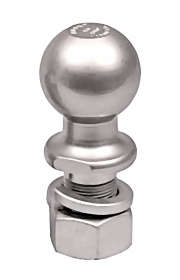 Things that affect strength for the ball are: First, the size. They come in several standards like 1-7/8″, 2″, 2-5/16″ etc.. Second, the shank diameter. The shank is the bolt portion that holds the ball to the drawbar.
Sometimes the shank is a threaded portion sticking out of the ball (effectively a bolt). Sometimes the shank is actually a bolt that threads into the ball. Either way, they come in a variety of sizes from 1/2″ to 1-1/2″. As you might imagine, the larger the shank, the stronger the ball – usually.
A good rule of thumb: When it is close, step it up. Much better to be too strong rather than not strong enough.
Ball Options
There are a ton of options available including many of combinations of height and shank size. Pick one that works for you. The most important things are the size – must match the size of the trailer coupler – and the weight rating. A ball that is too large will not fit in the coupler, and a ball that is too small may pop out while driving.
Load capacity is not something you can see because it involves the manufacturing process as well as the material and heat treatment. Just like you cannot tell one grade of bolt from another without markings, you cannot tell one grade of ball from another without markings either. Just follow the load rating listed, and do not worry too much about the trailer hitch class ratings.
Most are steel. Some are raw steel, some with a chrome plating, and some with galvanized coating. Others are stainless steel. Though they do not give the alloys, the strongest ones are steel, and the most expensive are Stainless. Stainless resists weather the best, then Galvanized, then Chrome. Mostly your ball is covered in grease, so weather is less of an issue anyway. Just take the drawbar out when you are not towing.
The Lowest Rating Wins
Just remember, in all of this choosing, the component with the lowest rating wins. In other words, if you have a Class 5 receiver and a Class 4 Drawbar, and a Class 3 ball, the system is only Class 3 overall. The lowest rating wins, and that includes the trailer hitch (coupler) too.
Yes, Trailer Hitch Class Weight Ratings are nice to categorize hitches so you know basically what you can tow. Yet, as noted above, they are not always consistent from one manufacturer to another. Please make sure you read the labels.
I am a fan of the receiver and drawbar system – except they sometimes “rattle” when towing – but that is minor. In my personal arsenal, I have several ball mounts with different “drops”, ratings, and ball sizes depending on what I need to tow. That makes it super simple to make a switch to one trailer or another.
While there is always more to learn, that is it for this article. You can chime in about trailer hitch class ratings in the comments section below. Enjoy.



Comments