

Tires. There are a million tires out there with a ton of classifications and designations. How do you choose: What tires for your trailer? That is not a silly question at all.
Truly, the tire industry can feel like black magic with all the various designations to keep straight. Then, at the tire store, they rattle off the numbers and letters so fast your head spins. Do I really want that? Will I look silly if I ask too many questions? While it may feel intimidating, NO, you are not silly asking questions. You are learning, and that is important.
The real problem with tire stores is the people you interface with a sales folks. Their job is to get you out the door with new tires. Best if they can sell you what they have in stock, add a lengthy warranty and they are done. That is a little at odds with your goal – of getting the RIGHT tires to serve you best down the road. So, to do that, knowledge is your friend.
Anyway, an informed customer is better to work with. And, if you come prepared, it is much more likely that you will walk away with the right tires. So, dive in for a little tire knowledge.
First, Tire Designations
Tires have a bunch of different types of classifications, and not all tires are consistent. For the sake of space, we will talk about the most common, and refer you to Google to find the odd-balls.
The most common way of defining a tire is with this formula that also appears on the outside of your tires. It is normally raised rubber lettering on the sidewall in a form like this:
(Service Type) (Width)/(Aspect Ratio) (Construction)(Rim Size) (Load Index)(Speed Rating) (Load Range) (Extras)
Appearing something like this:
LT 215/75 R15 106Q D1 BSW
What can I do with that? Don’t worry about the details, because even the tire experts have to look up some of these things. And to keep you on your toes, sometimes they mix things up a little or leave parts of it out. Anyway, here is how to decipher it.
Deciphering Tire Codes

Service Type — Passenger Car (P), Light Truck (LT), Trailer (T or ST), etc.. There are more, but we will skip those for right now. For trailers, we recommend LT or ST for most. See Trailer Tires or Automotive Tires for more information. Some small tires have different designations, but we will leave that for later too.
Width — Nominal tire width in millimeters from bulging side to bulging side. It is NOT the width of the tire tread, nor the width of the bulge from the weight of the vehicle resting on the road. It is the “theoretical” widest point of the tire when properly inflated and sitting by itself. (If you start measuring, they are not usually exact.)
Aspect Ratio — This is a percentage number of the tire section Height to the Width. This is the tire section, NOT including the wheel. See the image. If you have a 75 aspect ratio, that means the distance from the rim diameter to the tread is 75% of the width.
Construction — The way the tire is made. Radial (R) is all you really need. While there are more, like (D) for instance, Bias ply tires are not as available for consumer applications. For heavy trailer applications, however, there are some.
Rim Size — This is the tire seat diameter in inches, and it must match the rim. It is NOT the total outside diameter of the rim. Interestingly, rim width is not part of the tire designation, but it is important when buying your rims and tires. Since the tire is flexible, it will have a range to work with, like 6.5″ to 8″ rim width or something. The rim is obviously rigid, so make sure your tires fit the rims.
Load Index — This is a specification for load the tire will carry, but it is actually a code. 106, for instance, means it will carry up to 2094 lbs. You just have to look up the index number based on the load capacity you want. Here is a page with charts for both Load Index and Load Range from Discount Tire. Because this is so important, we also have another trailer tire article to discuss the finer points.
Speed Rating — This tells the max speed for the tire. Again, it is a code to look it up. From our example above, Q means up to 100 mph. Since many trailer tires are more like: L – Up to 75 mph; M – Up to 81 mph; N – Up to 87 mph, make sure your tires are made for the speed you travel. Here is a chart of Speed Ratings.
Load Range — Again, a coded number to show the layers of construction and max pressure rating of the tire. Standard Load (SL), Extra Load (XL), C, D, E, F, G, H and maybe with a number like a “1” – E1 for instance. Originally this indicated bias ply ratings, but now it is more about inflation pressure. For example: Load Range D = 65 PSI, Load Range E = 80 PSI. This is less important, because the Load Index is really a better way to choose a tire.
Extras — While there are additional things to appear at the end, most are not so important for function. Things like BSW (Black Side Wall), or a manufacturing code, or other things may appear.

Selecting Tires For Your Trailer
Choosing the right tires for your trailer can be a little daunting for many. If you have a trailer, it is often easiest to replace a tire with a new one of the same designations. While that seems right, it can also be misleading, because unfortunately, we see too often where trailer manufacturers take shortcuts to save a few pennies.
Check the Load Index and the Speed Rating in particular, then make sure the tires you are buying have ratings above the axle capacity. See the discussion below for recommendations, and more about choosing tires for your trailer.
Then, Wheel Designations
Wheels (also called rims) are much easier. They come with a load capacity, a diameter, a width, a bolt pattern, and an offset. Some also include a pressure designation, but mostly that is part of the load capacity. This image from Katana Wheels is a nice diagram of the rim an some of the specifications.
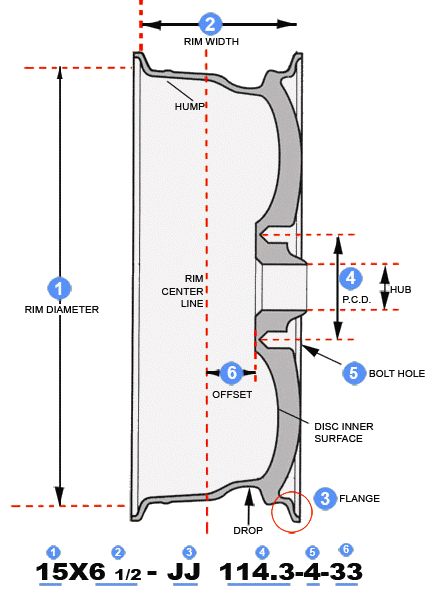 Rim Diameter — The tire seat diameter. This is not the actual full diameter of the wheel. It is a matching diameter that must match the tire size. Rims come in many sizes that, in shorthand, define the wheel – like a 14″ or 15″ wheel. This is the primary measure.
Bolt Pattern — A designation of how many bolts there are in what size pattern. The bolt pattern must match the axle pattern. It is often given as 5 on 5″ or something like that – which deciphers as 5 holes on a 5 inch (bolt circle) diameter, equally spaced. Higher capacity wheels have more holes on larger a Bolt Circle Diameter. Examples are 6 on 5.5″ and 8 on 9″ diameter. Read How To Measure A Bolt Pattern for much more information.
Width — Rim width is the space between the flanges where the tire goes. This is a linear dimension like 7″ and it must match within an acceptable range for the tire. A wider rim allows more tire “bulge”. Trailer specific rims tend to be on the narrower side for clearance. Just make sure the tire specifications match the wheel width, diameter, and load capacity.
Offset — This is usually zero for trailer wheels. The offset is a distance from the center of the wheel to the mounting face. We sometimes call it “Dish”. On Front Wheel Drive cars, they have an offset “out” to allow more space inside for the axle shafts. Dually applications have a large offset so wheels can bolt together with space still between the tires. Choosing wheels with an offset other than zero can allow the tires to “stick out” or “pull in” a little. Generally we don’t do this with trailers because it loads the axle bearings different which de-rates the axle load capacity. We recommend sticking to Zero Offset to avoid trouble.
Choosing Tires For Your Trailer
Now we have the fiddly details out of the way, we will talk more specific about tires for your trailer. Not every tire is appropriate for a trailer. Of course you can put the wide, low aspect ratio tires on a trailer if you want, maybe to match the tow vehicle for show. Those are always fun to see. However, in a more practical sense, there are many we can easily rule out.
Size Things to Consider
In general, smaller diameter wheel sizes carry smaller diameter tires – and less total load. On the other hand, smaller tires offer a lower deck height and less vertical intrusion above (smaller wheel wells, fenders, etc.), albeit, they also give less ground clearance.
In general, wider tires carry more load. While a wider footprint is nice in some ways, they do require a little more space side to side. If you drive a lot over soft ground – like a lawn, deep gravel or sand – wider tires are helpful.
Tire pressure can be a big deal, especially if you pull your trailer around empty. Trailer “bounce” is a real thing, and pressure is one way of dealing with it as mentioned in this article about trailer bounce. Small tires with high pressure are particularly susceptible. Choosing tires with a larger Aspect Ratio (like 80 or 90) can help because there is more sidewall to add a “suspension” effect.
Speed and Load
The Speed Rating and Load Index numbers mean a lot more than just what is safe. Don’t skimp on either of these. If you think you will never pull your trailer on the highway – then buy tires rated below 75 mph. BUT, what if you need to be on the highway and find traffic is moving all around you at 80+ mph? Don’t flirt with it. My personal opinion is there is no reason to even consider a tire with a speed rating lower than N.
I approach Load Index the same way. While it is easy to think about axle capacity translating directly to tire capacity, it is again ignoring the way things actually occur. Tires are often overloaded, accidently, or by dynamics (like going around a corner). Since tire failures with trailers are not uncommon, it does not make sense (to me) to skirt by with the minimum. I argue to use tires that have 15% (or more) extra capacity. See the discussion below for an example with numbers.
Common Sense Problem Avoidance
If you can keep a problem from happening, that is much better than solving a problem later. Trailer tires certainly fit this category. Tires and tire issues are the #1 cause of trailer towing problems on the road. How many times have you seen a trailer on the side of the road with a wheel missing? Seriously, this is something we can avoid with a few common sense steps.
First
Above all, make sure the tires are are in good shape. If there is dry rot, or sidewall damage, or extra bulges, or uneven wear – fix things BEFORE pulling the trailer. If axles are not straight, for instance, it can cause extra tire wear. The wear itself is not the issue – rather, the heat generation with the wear that denigrates the tire core (which you can’t see). That weakens the tire and at some inopportune moment, it will give way.
Avoidance is easy. Simply inspect the tires before going. Most of the time the signs are there early telling you when to replace worn trailer tires. Another good indicator is heat. Put a hand on the tires and the hubs when you stop for gas. If the tires or wheel bearings are hot, fix it before continuing.
Second
Make sure your trailer is ready for the service you want. I see a lot of trailers that are “probably” overloaded. I see even more with an axle situation that causes tire overload – read about proper axle load sharing. It is not very easy to change trailer in a moment, but maybe you can take 2 trips, or adjust other things if what you are trying to do does not fit the available equipment.
The same can be said for equipment that is no longer ready for the load. See this obnoxious tire situation that changed their plans. The signs were there . . . so in some warped sense, they asked for the problems. That does not need to be you.
Third
Choose trailer tires with more capacity than you need. I recommend 15% or more over. Here is an example with numbers.
If you have a 3500# axle, each wheel and tire must handle at least half of the load (because there is a tire at each end of the axle). That would say 1750# capacity for each. Looking at the charts, a Load Index of 100 for 1764# fits the bill. Right? Not in my book. This example assumes both ends of the axle carry the same amount, yet rarely are trailer loads perfectly even.
Secondly, when you go around a corner, the outside tire carries more due to centrifugal force. If tires are near the limit standing, then one overloads at every corner.
Of course, manufacturers make tires to handle some amount of overload for situations like cornering and bumps in the road. So, if you are pushing the limits, then you are flirting with disaster. Yet, it is only a small price difference for tires with 15% extra capacity.
Using the example above for the 3500# axle, add 15% to the 1750# making it 2012# as the minimum tire capacity. That is Load Index = 105 for 2039#. It is such a simple way to avoid problems.
Fourth
Getting beyond the tires themselves, when you put new tires on a trailer, make sure they go on right. For a little more information, follow this link to know more about trailer wheel bolts, and how often to tighten them.
Fifth
Though not specifically about tires, make sure your axle spindles operate properly and have appropriate grease. Yes, it takes a few minutes, but take the time to inspect at least once a year – especially if the trailer is stored outdoors.
It is really pretty easy. Jack up one wheel and spin it. Listen to it. If it spins well and has no scraping or grinding noise, go on to the next. Every couple years, you should also pull a wheel and hub to check the bearings and grease. If you have a boat with a trailer that goes in the water, you should check the bearings every season – maybe more often. If you travel long distances or on frequent trips, check the bearings more often.
Is this ridiculous? Sometimes the grease will last for years. However, when it fails, it is usually catastrophic, and it is NEVER convenient.
Finally
Check function of brakes once in a while.
There was a car pulling a trailer in Idaho years ago with a locked brake. It heated up the hub and wheel enough that the tire caught fire. It actually started a series of fires all along the road – resulting in a huge forest fire. Horrible. The state sued them for the cost of fighting the fire. All of it was preventable.
On another occasion, someone pulled one to me with the “park brake” still engaged, and it took a few hours till it cooled enough that we could take the wheel off. Completely cooked the bearings and grease. A simple, but costly mistake.
Just do it as part of the normal checks and regular maintenance – or take it in for the service. Like the old saying . . . an ounce of prevention saves a pound of cure.
Good Luck with Tires For Your Trailer
Ah, but we can make our own luck. The most common problems are mostly avoidable. Do regular inspection and maintenance, and go a little overrated with the specifications. Oh, and avoid the overload.
Now you know one HUGE secret to trailer towing success.


Comments